
A walk through the Exchange District isn’t complete without taking in the diverse public art that adds colour, character, and meaning to the neighbourhood. Set against a backdrop of cobblestone streets and historic buildings, these works range from vibrant murals and playful designs to monuments that honour pivotal moments in Winnipeg’s history.
Take a digital stroll through the public art that helps make the Exchange District so unique.
1919 Marquee Monument
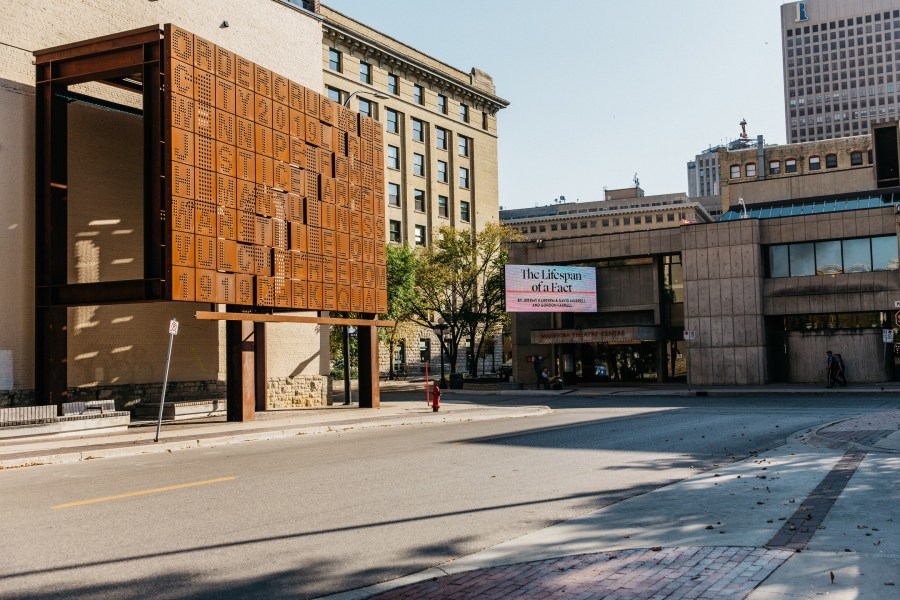
The Marquee Monument stands near the site where a violent confrontation helped ignite the Winnipeg General Strike in 1919, serving as a reminder of one of the most pivotal events in Canadian Labour History. Its design is by Monteyne Architecture Works, who beat 13 other design firms out in a competition held by the City of Winnipeg in 2016. This weathering steel installation reflects the tensions, oppositions, and ideals that defined the 1919 Strike, and continue to echo in today’s political and social conversations. Its bold, angular form is both new and old at the same time, positioned to be visible from key points like City Hall and Rorie and Lily Streets. Monteyne Architecture set out to create a unique and memorable civic space where all members of the community are welcome, and this powerful monument succeeds in doing just that.
📍Corner of Lily Street and Market Ave
Bloody Saturday Monument

The Bloody Saturday Monument is another piece that pays homage to the 1919 Winnipeg Strike, this time honouring the story of Bloody Saturday. The monument commemorates the protest led by returning WWI veterans that ended in violence, death, and a torched streetcar. What began as a silent demonstration escalated after strikebreakers drove a streetcar into the crowd, prompting protesters to overturn and set it ablaze. The response of mounted police and private militia was swift, causing the death of two protesters and the hospitalization of another twenty-seven. On June 21, 2019 – 100 years to the day after Bloody Saturday – this monument was unveiled at the site where the streetcar was overturned, offering a reminder of the high cost of the fight for workers’ rights.
📍 Main Street and Market Ave
Imagine, MTC

Outside the Royal Manitoba Theatre Centre stands Imagine, MTC, a bronze sculpture created by renowned Canadian sculptor Ruth Abernethy. The piece honours MTC co-founders John Hirsch and Tom Hendry. Hirsch is depicted standing, gesturing skyward as if envisioning a theatre company in the clouds, while Hendry sits beside him, scratching his chin, perhaps lost in a thought of his own. The monument was installed in 2008 to mark the theatre’s 50th anniversary, a date that’s also meaningful to Ruth, who is a former MTC employee. The lifelike statue is a favourite of the thousands of Winnipeggers who visit the theatre for festivals and shows.
📍 174 Market Ave
Murals
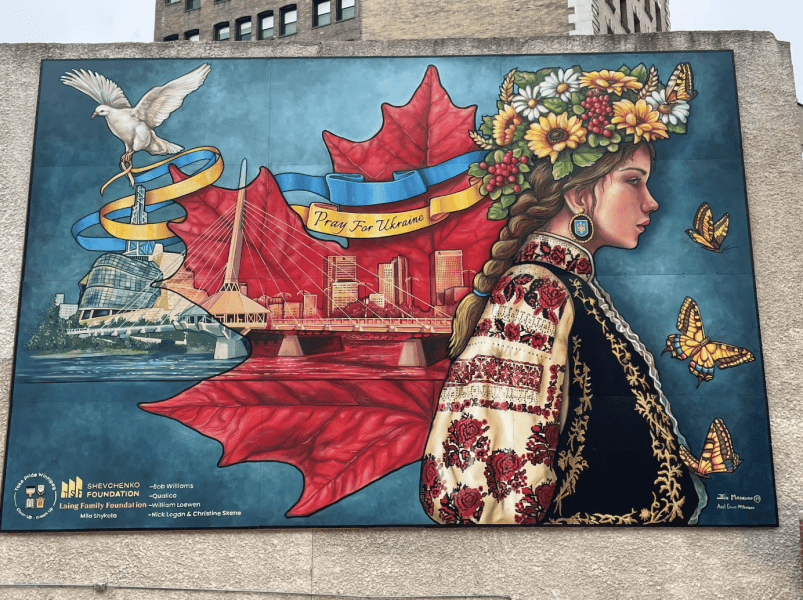
Heritage buildings in the Exchange District are the perfect canvas for large-scale art pieces. The street art in the Exchange adorns the side of buildings, adding modernity and colour to historic spaces. Each piece tells its own unique story, whether that be about the area, the artist, or a facet of the human experience. The newest mural piece added to the collection in the Exchange pays homage to the people of Ukraine. Pray for Ukraine honours the more than 20,000 Ukrainian newcomers who have made Manitoba their home since 2022. You can check it out at 492 Main Street.
📍 Explore other street art in the Exchange
Poster Boards

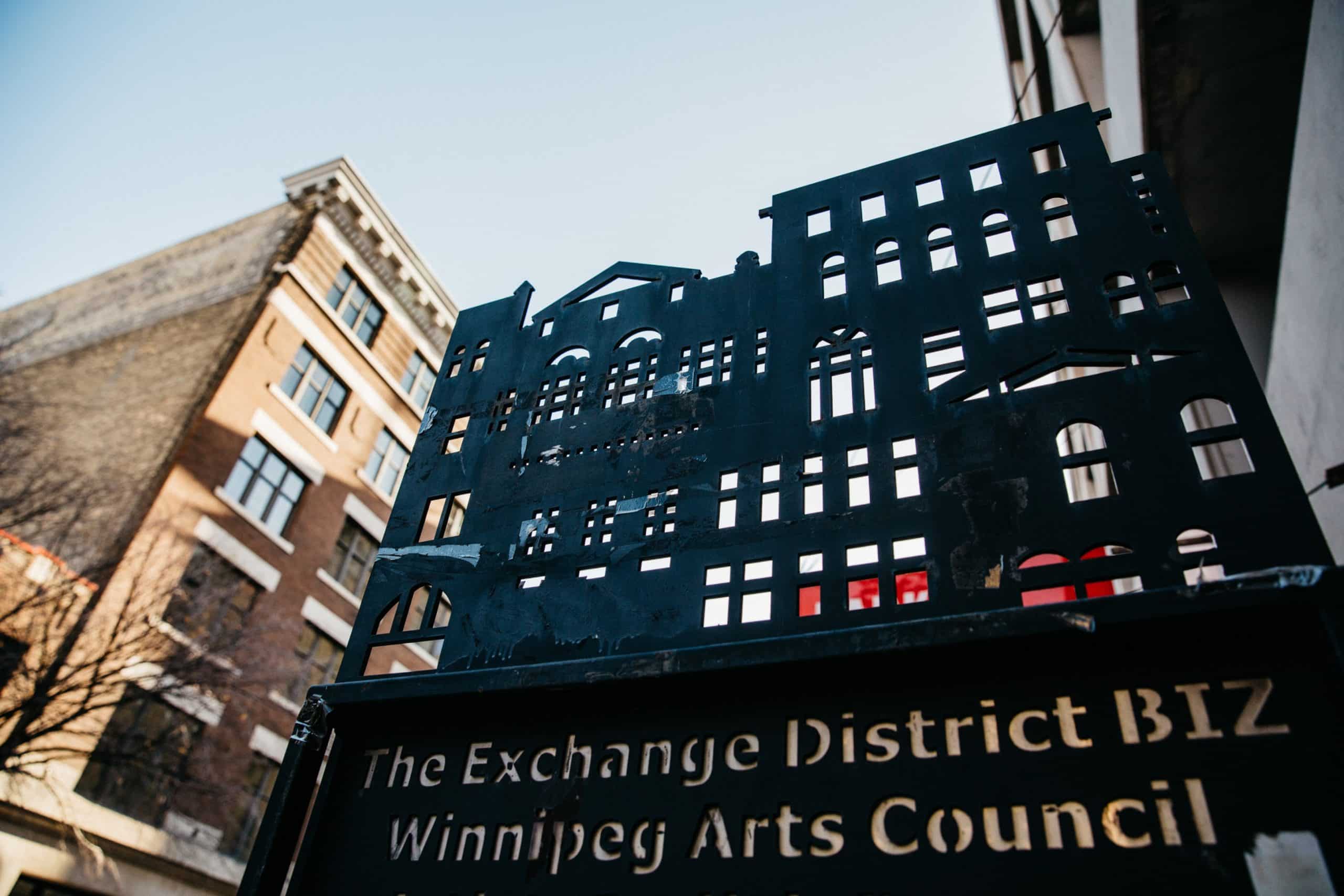
Scattered throughout the Exchange District, art-designed poster boards offer a meaningful canvas for posters, neighbourhood notices, and anything else you can think of to stick on them!
Created in partnership by the Exchange District BIZ and the Winnipeg Arts Council, these boards serve both form and function, providing space for event posters while showcasing original artwork. When the original boards needed to be replaced, a call went out to local artists, resulting in over 100 submissions. The final designs, by Winnipeg artists Michael Carroll, Laurie Green, and Judith Panson, now have a permanent home in the Exchange.
Selkirk Settlers Monument

The Selkirk Settlers Monument tells the story of Scots who were forced from their homeland and found a new beginning in Winnipeg. Between the late 1700s and early 1800s, thousands of Scottish families were evicted from their ancestral lands by landowners chasing profit in an event known as the Highland Clearances. It’s a violent and tragic chapter in history, marked by families being burned out of their homes, sold into slavery, or packed onto overcrowded “coffin ships.” Many eventually made their way to Manitoba. This monument, created by sculptor Gerald Laing, has a twin in Helmsdale, Scotland, and depicts a family of four setting out in search of a new home. It honours those who endured great hardship in pursuit of hope, including the group supported by Thomas Douglas, the Fifth Earl of Selkirk, who helped establish Manitoba’s first agricultural settlement in 1812.
📍 Waterfront Drive and Bannatyne Ave