
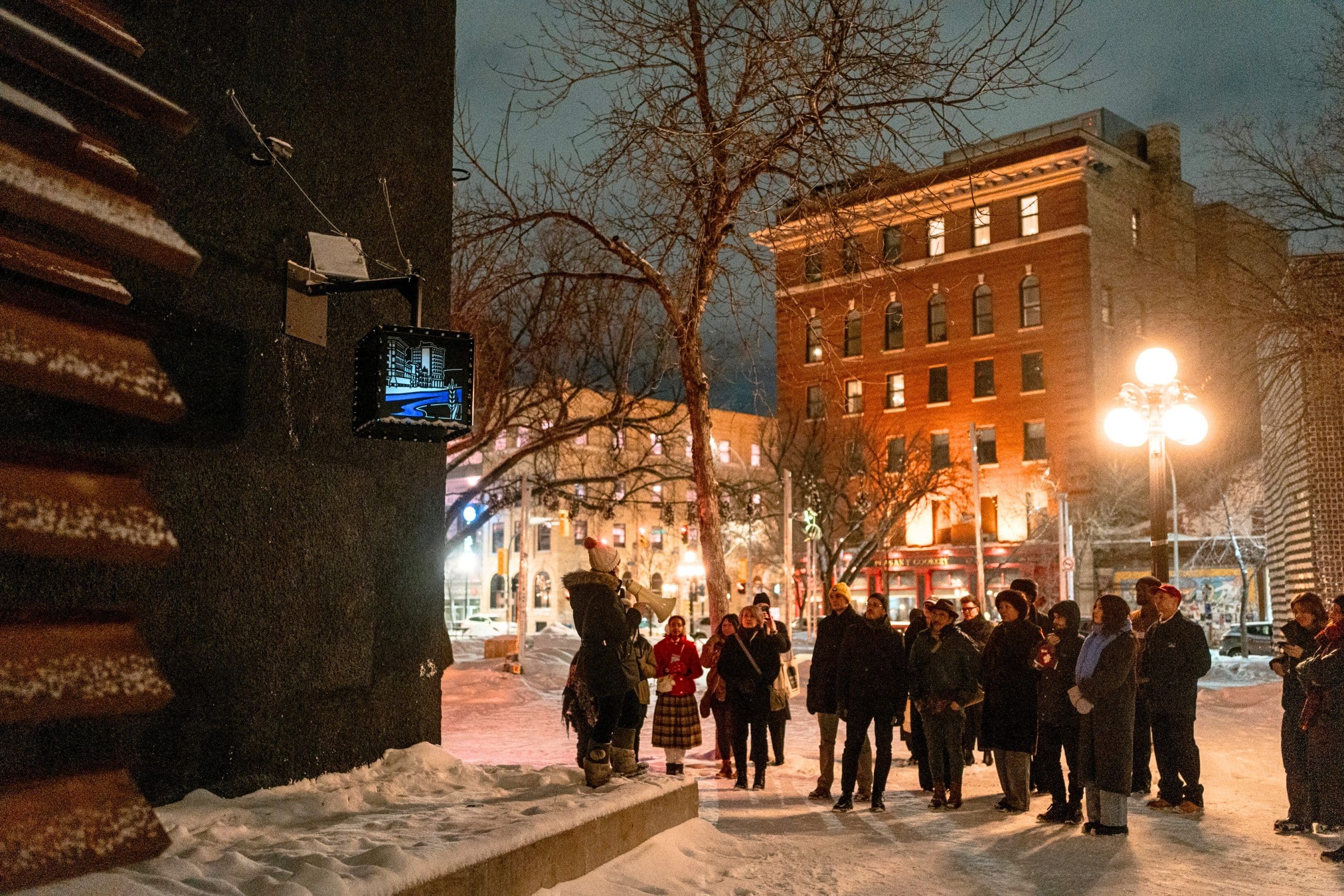
The installations of Lights on the Exchange include lanterns that cast light on cobblestone streets and heritage buildings. Around corners and atop buildings, these lanterns serve as guideposts, illuminating untold stories of the Exchange District’s past, present, and future.
With solar-powered lanterns curated by the Winnipeg Arts Council, discover the artists who have illuminated the Exchange with their stories.
Bistyek

In Bistyek’s lantern, ‘Light’ symbolizes hope, identity, and belonging. His installation for Lights on the Exchange is inspired by the Arabic word “daw” (ضوء), which means “light.” By blending Arabic and English in his piece, Bistyek bridges cultures and languages, highlighting his own journey as a Kurdish-Syrian refugee who has made Winnipeg his home.
“When I moved to Canada and took Winnipeg as home, I wanted to see pieces of art that reflected my identity,” he shares. “I am Kurdish myself. I am a Syrian refugee who came to Canada, so doing this piece was really important to me, to give hope and light to other newcomers and refugees.”
For Bistyek, The Exchange District is the perfect place to convey this message. It’s where he has lived, worked, and created for years. His studio was once based in the neighbourhood, and his art has become part of its landscape. His first mural in Winnipeg, “Refugee, Refugees,” adorns the side of Danook Restaurant at 58 Albert Street. The piece features two families, representing displaced people and their journeys, and is accompanied by two powerful messages: “Being a refugee is part of the story, not the whole story,” and “They left not because they wanted to.”

The impact of this mural was immediate. “People reached out from different places — refugees, immigrants, anyone who had moved from their homeland,” he recalls. “They told me, ‘We really feel this. We get this.’” By sharing his own story of being a refugee, Bîstyek connected with a community of people with similar experiences. For him, creating that connection and sense of belonging is deeply meaningful.
His Lights on the Exchange lantern continues this theme, illuminating the stories of those who come to Winnipeg seeking a new home. “There’s a lot of richness and untold stories here, and my piece invites people to see beyond the architecture. Within the buildings are studios filled with people, creatives, artists, and so much great energy.” The people and diverse histories that make up the fabric of the neighbourhood are what truly lights up the Exchange.
“When I moved to Canada and took Winnipeg as home, I wanted to see pieces of art that reflected my identity,” shares Bîstyek.
Through his work, Bistyek reminds viewers that stories of migration, resilience, and hope deserve to be seen and celebrated. You can see Bistyek’s piece for Lights on the Exchange at 155 Bannatyne Ave, his mural at Danook at 58 Albert Street, or two pieces in the Collab Shop at 246 McDermot Ave.
Instagram: @bistyek_
Website: https://bistyek.ca/
Justine Proulx
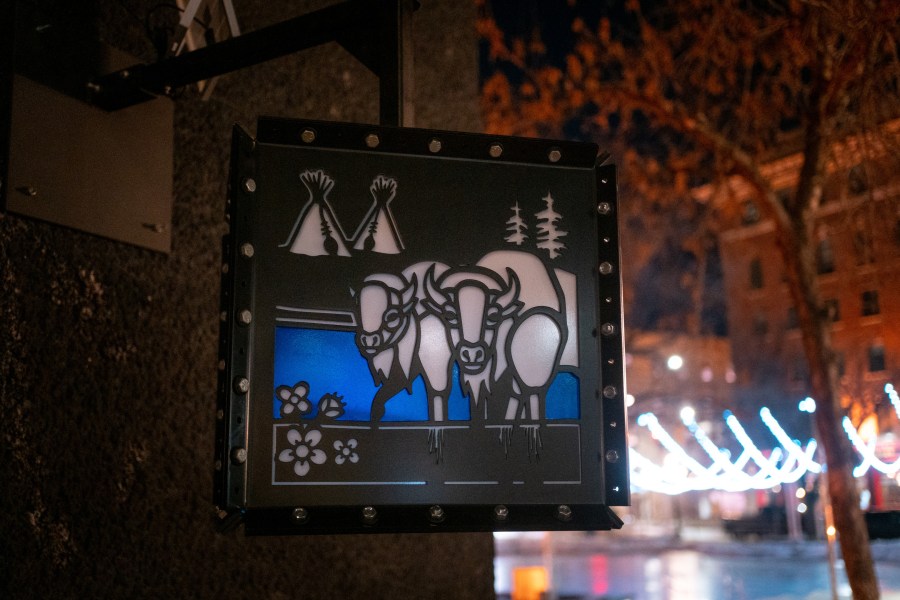
Justine Proulx’s Lantern, “Indigenous Perspectives on the Exchange,” offers a layered reflection on Indigenous history in Winnipeg. As an artist with Métis, Cree, and Ojibwe ancestry, she brings a deep awareness of the Indigenous experience and can share stories through that lens. Her piece tells the story of how Indigenous contributions have shaped the city’s growth and sees the Exchange as a site of resilience, trade, and transformation.
Her lantern unfolds in three distinct panels, each representing a different chapter of the city’s past. The first is dedicated to First Nations and the bison that once roamed freely across these lands. “In the Seven Sacred Teachings, the bison represents respect,” Justine explains. “It sustained the original people of Manitoba. We used every part of it for food, clothing, and tools. Colonization nearly wiped them out, but their presence in the teachings reminds us of our connection to the land and each other.”
The second panel moves into the era of the Red River Settlement, featuring voyageurs and Métis traders who shaped early Winnipeg through trade and transport. “The Métis played a huge role in shaping this city,” she says. “The Voyageurs travelled and portaged, carrying supplies, furs, and food for the people living in the area that’s now the Exchange District and the Forks. They created the foundation that this city was built on.”
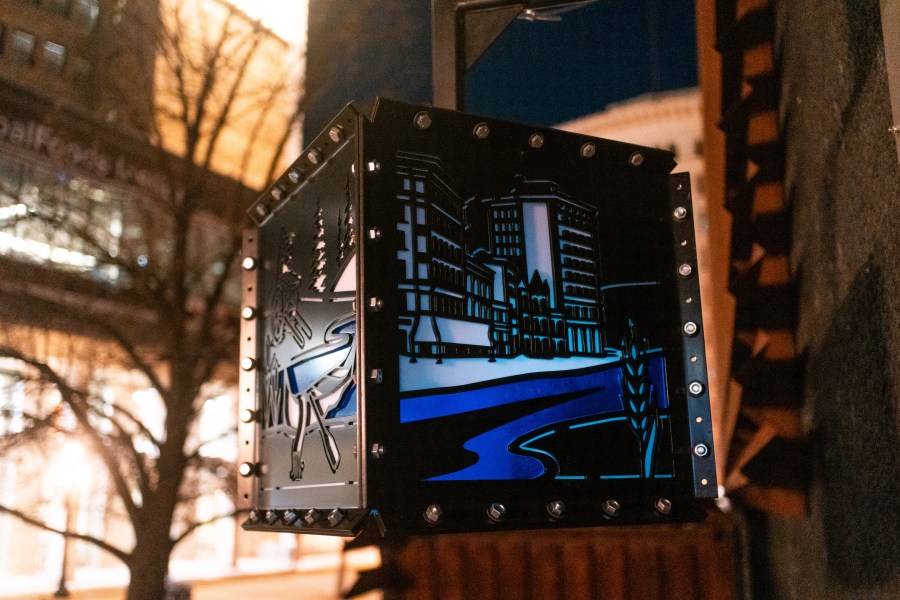
The final panel shifts to modern times, depicting historic buildings of the Exchange, once a hub for the Winnipeg Grain Exchange. Back then, Winnipeg was known as the “Chicago of the North” for its role as a powerhouse in Canada’s agricultural economy. “Winnipeg was growing so fast,” Justine notes. “Trade was booming, and the city was becoming something big. But I want people to ask ‘at what cost’? Who sacrificed what to make this city what it is?” Her lantern asks viewers to think critically about the past, acknowledging that progress and prosperity have often come at the expense of Indigenous communities. “I wanted this lantern to serve as a reminder that a lot of our city’s success is rooted in a history that’s tainted by colonization,” she shares.
Justine’s work aims to keep Indigenous stories alive, ensuring that histories are not forgotten. “A lot of newcomers to Canada don’t know the history of Indigenous people here,” she says. “My partner moved from Brazil five years ago, and he had never heard about residential schools. His friends and family hadn’t either. That’s why it’s important to keep telling these stories and continue educating people and bringing those issues to light.”
“The Métis played a huge role in shaping this city,” she says. “The Voyageurs travelled and portaged, carrying supplies, furs, and food for the people living in the area that’s now the Exchange District and the Forks. They created the foundation that this city was built on,” shares Justine.
Lights on the Exchange offers that space for reflection, storytelling, and connection — things Justine sees as intrinsically tied to winter in Indigenous culture. “Winter has always been a time for storytelling,” she says. “There wasn’t as much to do, no electricity, no TV. People gathered, shared knowledge, and prepared for Spring. I love that this festival carries on that tradition.”
You can visit Justine’s Lantern at 131 Albert Street.
Instagram: @justineproulx
Website: https://www.justineproulx.com/
Yisa Akinbolaji
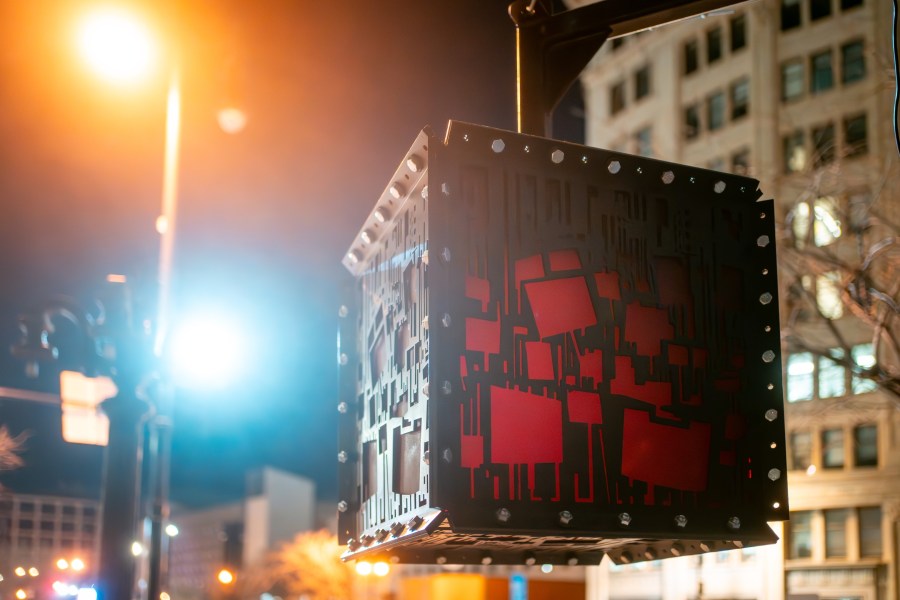
Yisa Akinbolaji’s piece, ‘Peaceful Protest: The Dividend of True Democracy,’ tells the story of the Winnipeg General Strike of 1919. It underscores the power of peaceful protest and collective action, bringing the spirit of the strike to the present. The piece is installed on the site where workers once rallied for fair wages and better conditions, across the street from the Bloody Saturday monument on Main and Market. Yisa’s lantern serves as a tribute and a call to reflection.
Yisa’s piece began as a digital line drawing before being fabricated in metal, allowing for bold, graphic imagery that reflects impressions of people carrying protest signs. “I created it in a contemporary, entertaining and somewhat symbolic form. To me, any peaceful protest is a positive engagement that aims to bring about change for the better in any civilized society,” shares Yisa. In the piece, the protestors’ faces are obscured. Instead, the image creates ‘barcodes’ that symbolize commerce, negotiation, and economy, elements tied to the Winnipeg General Strike and other contemporary movements for social justice. “The piece serves as a memorial, emphasizing the positive impact of peaceful protests and the importance of collective action for human rights and equality,” Yisa says. He envisions an even larger version of the work, believing its message will remain relevant for years to come.
“The piece serves as a memorial, emphasizing the positive impact of peaceful protests and the importance of collective action for human rights and equality,” shares Yisa.
To Yisa, the Exchange District represents a convergence of history, culture, and community. It reminds him of Tinubu Square in Lagos, Nigeria, where he lived and practiced art before immigrating to Canada in 1997. Both places share a sense of convergence — of past and present, commerce and culture, resilience and reinvention. “The Exchange District is a vibrant hub where history, creativity, and community intermingle,” he says. His work invites viewers to see it not just as a preserved historical site but as a living, evolving space shaped by the people who pass through it.
You can see Yisa’s work at 492 Main Street in Bijou Park in the Exchange.
Instagram: @yisaakinbolaji
Website: https://www.yisagallery.com/