

The installations of Lights on the Exchange invite viewers to see the world in new ways, like through the interplay of light and shadow or through a tactile connection with nature. The installations tap into the history and energy of the Exchange District, while exploring narratives as unique as the creators who present them.
Meet two artists whose immersive pieces celebrate art and light.
Brian Gluck
Brian Gluck’s art is a study in contrast, function, and exploration, elements that speak not only to his technical skill but also to the inherent power of creative play. A Red Seal Machinist, musician, and woodworker, Brian’s work is driven by the act of fabrication itself. For Lights on the Exchange, Brian created “Shawl and Pillar,” the stage for the Poet Box. What emerged is a piece that plays with the concept of light and shadow, two opposing yet complementary forms that highlight the dynamic exchange of energy between performers and the audience.
Brian’s piece materialized from his desire to frame the performance space, using light and shadow as the central mediums of interaction. “I predominantly wanted to work with directing light and shadow, and catching light,” Brian explains. The venue for the project, Saintuary, also informed the piece and the inputs used. The space impacts the way Brian designed the piece, and Shawl and Pillar is meant to engage with the performers, uplifting what they are bringing to the project. For the poet box, that meant manipulating raw materials like wood and steel to form something that embodies the human experience and the myriad of emotions that come with it.
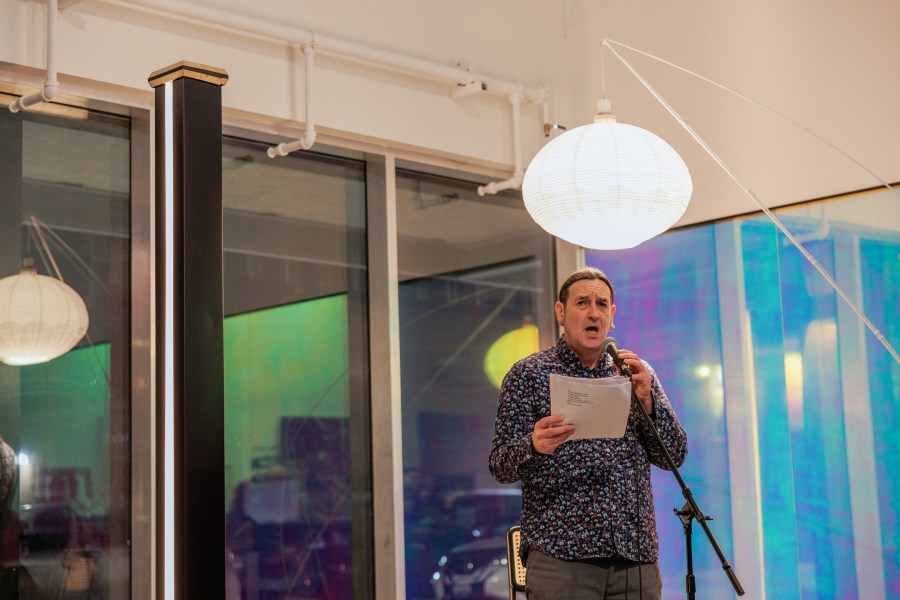
“The pillar reveals light along its entire length, referring to both the piece itself and the performer.”
Brian’s design combines two elements, the “shawl” and the “pillar,” each bringing a contrasting presence to the space. The pillar stands straight, representing simplicity and strength, while the shawl’s sweeping curves represent a softer, more welcoming energy. Brian intentionally placed these elements in tension with one another, allowing them to interact with the performers in ways that mirrored the emotional contrasts of softness and hardness in their performances. “I wanted to keep that stark contrast between the two elements and just make almost elemental versions of a square and a circle,” he explains.
The interplay of these contrasting elements offers a way for the performers to interact with the art itself. For Brian, the goal was to create a stage which encourages play, providing the performers with a backdrop that could both challenge and complement their movements. “The pillar reveals light along its entire length, referring to both the piece itself and the performer,” he says. This light, which moves from floor to ceiling, contrasts with the more enveloping nature of the shawl, which creates a sense of warmth and embrace around the performer.
Beyond interacting with the venue and performers, Brian is inspired by the method of manufacturing. After all, “There’s no better description of a cube than that of its construction,” he shares, quoting The Brutalist. He designs for manufacturability, aiming to reduce waste, create pieces with intention, and provide opportunities for observation and interaction. “There are so many ways that I’m inspired by these manufacturing principles that you maybe wouldn’t think of at the first step of your design. But as a machinist and a tradesperson, I can’t not think about those things,” he shares. His close relationship to design and manufacturing creates harmony and meaning throughout the process. “The allegory of the project is developing continuously as I use my hands to build the item.”
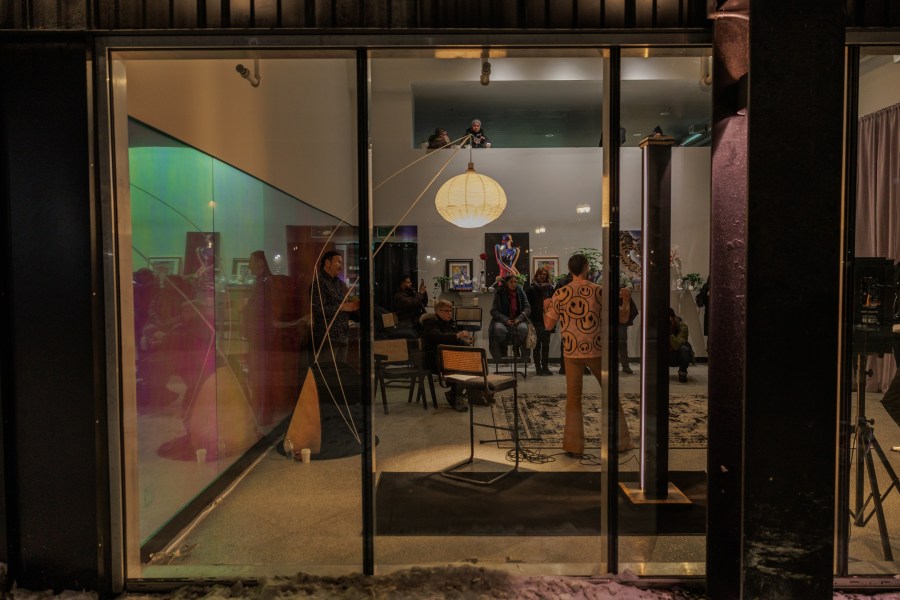
On a deeper level, Shawl and Pillar acts as an allegory for the Exchange District. “It’s an area of Winnipeg known for its blend of old and new, the abrasive and the welcoming,” he offers. The Exchange, like his work, embodies this duality — an area where art, culture, and community intersect in unexpected ways, and a place where visitors can explore and grow beyond their everyday experiences. Brian’s art, in this sense, mirrors the Exchange, offering something that both challenges and embraces its viewers.
Shawl and Pillar blurs the line between design and art, merging industrial precision with the fluidity of human experience. Brian’s work reflects his belief that meaning is found in the act of creation, not just the finished piece. Through light, form, and contrast, he invites performers and viewers into a space of interaction, challenge, and connection.
Experience Brian’s work in person at Saintuary, located at 100-123 James Avenue. And this Friday, March 7th, don’t miss the full performance with Tino Hove and Seream inside the Poet Box.
Instagram: @brian.gluck
Mamie Griffith
Mamie Griffith transforms spaces into experiences, blending history, community, and design. As a Dene/European designer with a background in architecture, she weaves Indigenous culture into the built environment, creating inclusive and sustainable spaces through collaboration. Her work spans production design, architecture, and landscape design, turning everyday environments into spaces of connection and reflection.
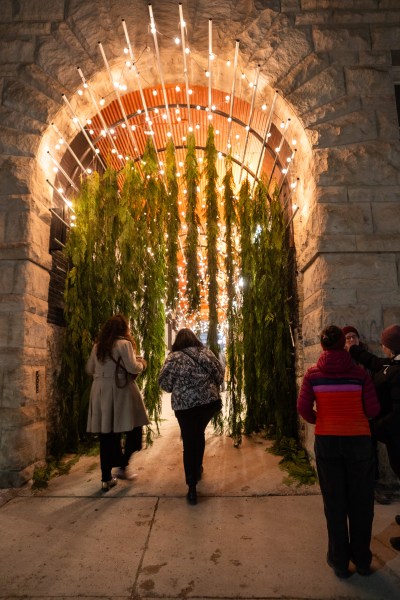
Her latest installation for Lights on the Exchange, “Cedar Tunnel”, continues this theme. Set in the Artspace Drayway, Cedar Tunnel is a suspended installation of cedar and other medicines carefully woven together with copper wire. Visitors can walk through the space, breathing in the earthy, grounding scent of the cedar while experiencing the tactile quality of the materials up close.
Cedar Tunnel isn’t her first foray into creating immersive, nature-driven installations. Last summer, she worked on a project for The Leaf at Assiniboine Park with Carmen Gray, a horticulturist of Cree heritage. Together, they designed a temporary floral and medicine installation that complemented the space’s architecture. That project, like her current one, was rooted in a collaborative process that brought people together to build something meaningful.
“Part of the work is the community build aspect,” Mamie explains. “People come together, work with the medicines, and create something together. That’s the beginning of the art piece for me,” shares Mamie. Volunteers from all walks of life can participate in the project, learn about the plants and medicines, and create something from the ground up.
This emphasis on shared experience is a central part of her work, extending beyond the volunteers who help bring the installation to life. Mamie is just as interested in how people will interact with the piece once it’s up. The Exchange District presents a unique backdrop with its mix of artists, small businesses, and unhoused communities. She’s curious to see how different groups will respond — whether they’ll find comfort in the space, use it as a momentary retreat, or engage with it in unexpected ways.
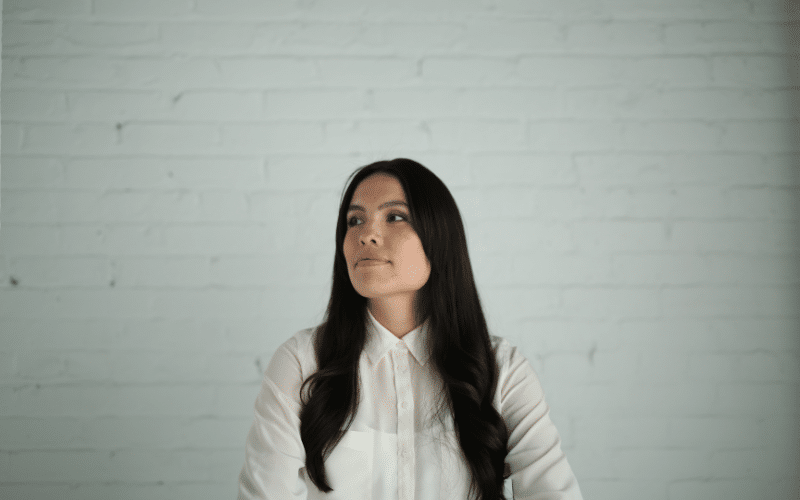
“People come together, work with the medicines, and create something together. That’s the beginning of the art piece for me.”
Beyond its sensory and collaborative nature, Mamie’s installation speaks to a deep history of the Exchange District that predates its storied warehouses and heritage buildings. “Before there were beautiful buildings, there were Indigenous folks meeting and sharing technologies back and forth,” she says. While writing her architecture thesis, Mamie studied the history at the Forks and downtown Winnipeg, reading architectural reports. She found that the area surrounding the rivers in Central Winnipeg is one of the densest and richest historical gathering places in all of North America. Her work acknowledges this history of gathering and exchange, a history often overlooked in favour of more recent narratives.
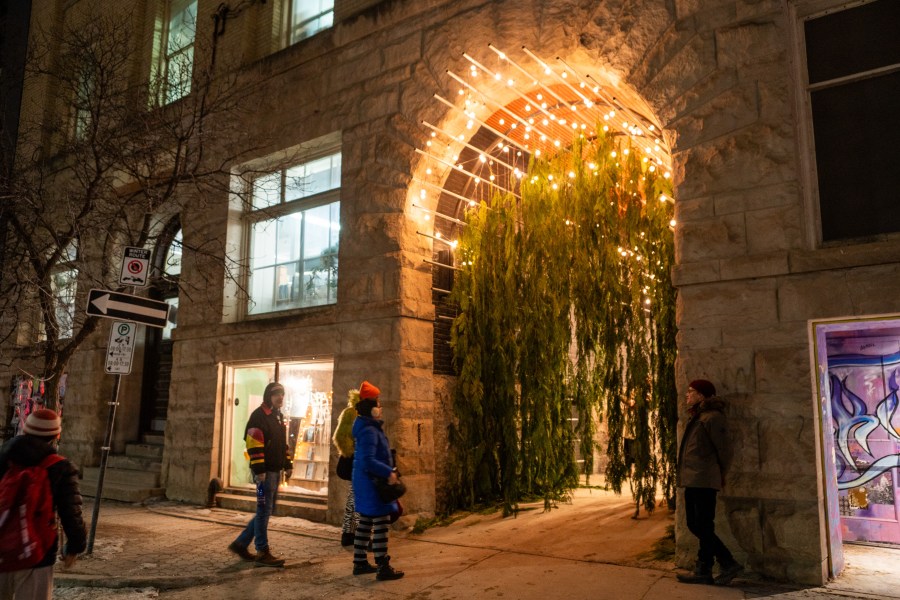
Mamie’s ability to bridge the past with the present is also reflected in her broader architectural work. As an independent contractor, she often collaborates with Tawaw Architecture Collective, led by Wanda D’Acosta, Canada’s first female Indigenous architect. Together, they work on projects across North America, blending architecture and landscape design in ways that center Indigenous presence and knowledge. Her art installations offer a counterpoint to these long-term projects. “It’s really satisfying to jump between timelines,” she says. “Something that takes years and something that we can conceive, organize, and build within a week.”
Whether designing a permanent structure or a fleeting moment of beauty, Mamie’s work is always about creating space for history, community, and a more thoughtful relationship with the land. And while her name is attached to the project, she’s quick to acknowledge that it wouldn’t be possible without the many hands that help bring it to life: the volunteers, the lift operators, the wholesalers, and the community members who show up to build something together. In the end, that’s what her work is really about: gathering, just as people have always done on this land.
You can see Mamie’s installation, which will be completed with a soundscape by artist Ashley Au at 100 Arthur St. – Artspace Drayway starting on Friday, March 7th.
Website: https://mamiegriffithdesign.com/